
Of the Making of the Assault Bike!

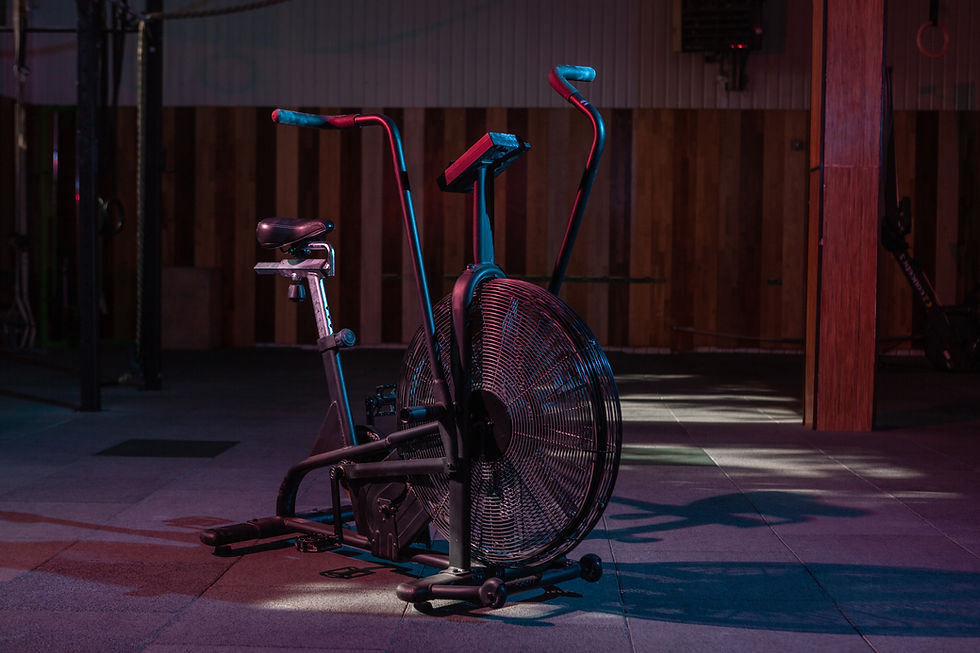
You might wonder why this topic is so important. Well, let me tell you!
It all started after I got introduced, more or less voluntarily (the culprits will recognise themselves!), to this wonderful, Machiavellian and somewhat deadly machine: the Assault Bike!
Oh yes… I am giving it capital letters… this instrument of pain is THAT powerful!
I initially intended to whine and complain about this contraption, and identify the, obviously, evil man who invented it. Unfortunately for me and fortunately for you (or is it the other way around?), I discovered that this topic opened to a cluster of rabbit holes!
You know the rules: we will start by a little bit of history, then go somewhat off track, before finally finishing on the topic at hand.
Where did it all begin?
It all started (or so history says) with a man called Francis Lowndeshad, who patented the Gymnasticon in 1796, the first recorded stationary bike.
According to the patent, in the words of the inventor himself, the machine was intended “to give and apply motion and exercise, voluntary or involuntary, to the limbs, joints, and muscles of the human body.”
If you find a picture of the machine, you will notice that it looks like an early version of the assault bike. Either that or it’s just trauma talking (MY trauma!).
Why did it all start?
If you think about it, 1796 in Europe was the aftermath of the French revolution. I would not personally have thought that this was a time favourable for inventors (guillotine excepted obviously… thank you Yorkshire for that one!), and yet here we are.
Well, it turns out that Mr Lowndeshad was an established authority on medical electricity, and more exactly the use of electricity as a therapy for both disease and injury. He even published a book on medical electricity in 1787.
Now, let’s pause for just a minute here. I am standing in 2025 wondering whether I would let a mad scientist pump me with electricity in the late 1700s … there was no fuse box I expect … how did you make sure you wouldn’t end up like a roast chicken?
But, I digress!
Why did this machine appear at that time in history? Well, around the same period, the science of orthopaedics was developing at a fast pace with the first orthopaedic institute being established in Switzerland by Jean-Andre Venel in 1780. The same man also opened the first school for midwives in 1778.
All in all, it was a period of progress as it relates to the treatment of disease and injury, through a better understanding of the body.
Before I explain how this all lead us to the Gymnasticon and the assault bike, let me tell you a little bit more about orthopaedic, because yes, it matters too!
Why is orthopaedic science important?
The first thing I would like to say is that I am sure glad for the progress of this particular medical field, which originally started on the battlefields. Let me tell you about the Middle Ages, where the injured were treated with bandages soaked in horses' blood, which dried to form a stiff, and rather unsanitary, splint. They do have point for effort, but not so much for the sterile environment! You might not die of a fracture, but you will die of infection.
I guess all scientific advancements are a succession of trial and error, but still, I am thankful to be living in 2025!
Orthopaedic science as we understand it today started making headway in the mid-1700s, when Nicolas Andry coined the term in the first textbook written on the subject in 1741, advocating the use of exercise, manipulation, and splinting to treat deformities in children.
This topic just grew from there at a steady pace, with medical doctors and surgeons deepening their understanding and establishing more tests and protocols, such as Thomas split for example, stabilising fractured femur.
Finally, the First World War resulted in a big push for the development and implementations of those techniques, particularly on injured soldiers, in and out of the battlefield.
It so happened that orthopaedic science is more than just the surgery aspect of it. Physical therapy and rehabilitation are also a significant part of it, which is exactly how the Gymnasticon came to be!
How did physical therapy start?
Now, that was a question I never asked myself, even though physical therapy is everywhere these days (I would include massages, yoga or Pilate in that category too)!
It seems one of the oldest references dates from 460 BC, with physicians like Hippocrates and later Galen, who are believed to have been the first practitioners of physical therapy, advocating massage, manual therapy techniques and hydrotherapy to treat people.
In his book The Art of Gymnastics, published in 1569, the Italian physician Hieronymus Mercurialis (1530–1606) introduced the term "medical gymnastics," highlighting one of the meanings of "gymnastics" as a dedicated rehabilitative tool for disabled subjects of any age.
In the 18th century, the French physician Nicolas Andry de Bois-Regard (1658–1742) established a solid link between the health of the musculoskeletal apparatus and physical exercise, and in his book Treatise on Orthopaedics, published in 1741, he introduced the new term "orthopaedics". And the loop is … well … looped!
Interestingly enough, if we go back to the First World War, women were recruited to work with and restore physical function to injured soldiers, and the field of physical therapy was institutionalized.
Treatment through the 1940s primarily consisted of exercise, massage, and traction. Manipulative procedures to the spine and joints of the extremities began to be practiced, especially in the British Commonwealth countries, in the early 1950s.
Bottom line? People realised as early as the 1700s that the body was a complex mechanical machine, and that there were ways to treat it and rehabilitate it to restore normal(ish) functions. This knowledge has just kept expanding, and there is still much to learn as the various modern trends and new discoveries for athlete training demonstrate. What I would say finally is, that while we reinforce our knowledge of the way body works, each body is different, and the same techniques do not work for everybody, nor do they always have the same outcome. This really is a fascinating science!
How exactly does all of this relates to the assault bike?
Well, as the body became less of a mystery, as people understood the importance of physical exercise whether it be to address an injury or develop as an athlete, new tools were developed.
It started with the Gymnasticon but didn’t stop there.
By the late 19th century, indoor bicycle emerged to enable exercise without outdoor travel, focusing on using bicycles for health and stamina building rather than transportation, and modern developments continued in the 20th century.
One example where bikes are used for physical therapy is cardiac rehabilitation programs, whether it be for recovery of heart related conditions or surgeries, as it allows for gradually improving cardiovascular health.
Surprisingly enough, I couldn’t find the name of the individual who came up with the original assault bike (called Airdyne bike), and maybe it took more than just one person…
However, I found the name of the company who birthed the machine in 1978, the Schwinn Bicycle Company, building bicycles since 1895! The need to innovate and maintain its superior position led, inadvertently, to the birth of the assault bike.
For decades Schwinn Airdyne dominated the market. However, during that time CrossFit training grew in popularity, and those crazy people started looking at ways to make their workouts harder (a little part of me is wondering “why, oh why people!”).
Enters Assault Fitness, a company who in 1994 released a new type of assault bike, partnering with the cross-fitters, and became known as one of the leading brands for designing and manufacturing heavy-duty, high-intensity cardio equipment.
There are now many other brands out there, but Assault Fitness and Schwinn Bicycle Company remain the top 2 in the market when it comes to assault bikes.
Alright, that’s all dandy, but what does that mean?
To summarise, we can thank Schwinn Bicycle Company for the invention of this torture device, and Assault Fitness for developing one providing an even harder training.
Without them, conditioning wouldn’t be as hard nor desperately excruciating. Thank you all for having created something that makes passing out a serious consideration with each session! What were you all thinking?
Alas, I do not see an end to using such bike anytime soon as, to my chagrin, the assault bike works terribly well.
So, I will get back on this devilish machine… but I will protest and mumble throughout … that is, when I can actually breath and talk!
Who know, maybe one day, I will think about that bike endearingly?
Sources:


